


Gordon Welchman - Bletchley Parks Architect Of Ultra Intelligence
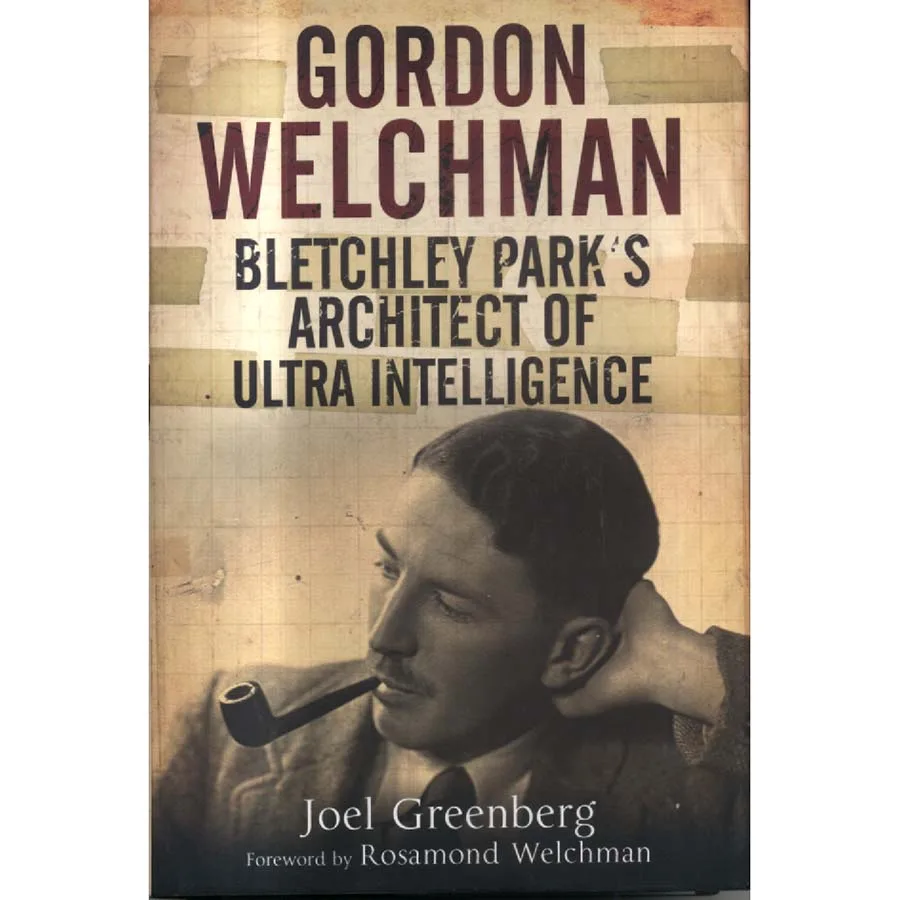
Publisher: Frontline Books
Format: Hardback
ISBN: 9781848327528
Gordon Welchman was one of the four original senior codebreakers recruited to Bletchley Park in 1939, alongside Alan Turing, Hugh Alexander and Stuart Milner-Barry. Turing became world-famous; Welchman became considerably less so, despite helping design the organisation that transformed intercepted German messages into usable military intelligence. History enjoys solitary geniuses and tends to become restless when asked to admire an excellent management system.
In Gordon Welchman: Bletchley Park’s Architect of Ultra Intelligence, Joel Greenberg restores Welchman to his central place in the codebreaking story. A Cambridge mathematician with no previous career in intelligence, he arrived at the Government Code and Cypher School shortly before the Second World War and was assigned to the problem of German military Enigma. His qualifications consisted largely of intelligence, mathematical insight and the national emergency.
Welchman became head of Hut 6, responsible for attacking Enigma communications used by the German Army and Air Force. The task was formidable. Enigma settings changed daily, networks used different procedures and every successful solution threatened to become obsolete before breakfast the following morning. German operators assisted occasionally through predictable habits, proving that even sophisticated cryptography remains vulnerable to somebody trying to finish a shift quickly.
His genius lay not simply in solving codes but in understanding the complete intelligence process. Intercepted messages had to be collected, identified, sorted, analysed, decrypted, translated and delivered to commanders while still operationally useful. Reading yesterday’s secret after tomorrow’s battle possesses undeniable historical interest but limited military value.
Welchman helped create the structure through which Hut 6 expanded from a small group of specialists into a large, highly organised intelligence operation. Mathematicians, linguists, clerks, radio intercept operators and machine staff all had to work together continuously. Bletchley Park’s celebrated breakthroughs depended upon thousands of people performing precise tasks, many of whom knew only the small portion necessary for their work.
He also recognised the importance of traffic analysis: extracting intelligence from the patterns surrounding encrypted messages even when their contents could not yet be read. Call signs, frequencies, transmission habits and changes in the volume of communication could reveal the structure and movements of German units. The message might remain incomprehensible while its mere existence behaved suspiciously.
Welchman made a crucial contribution to the development of the bombe machines used against Enigma. His diagonal-board concept greatly improved their effectiveness by exploiting relationships within the cipher system. It was the kind of elegant mathematical insight that becomes obvious only after somebody exceptionally clever has explained it and everyone else has agreed that they were almost about to think of it.
The resulting intelligence, classified under the designation Ultra, gave Allied commanders access to an extraordinary stream of German military information. It contributed to campaigns across Europe and North Africa, though its use required extreme care. Acting too obviously upon decrypted messages might reveal that Enigma had been compromised, forcing commanders to know something important while behaving as if they had learned it through less miraculous means.
Greenberg follows Welchman beyond the familiar huts and machines into the broader operation of Bletchley Park. The book shows how personal relationships, bureaucratic struggles and practical decisions shaped the intelligence effort. Codebreaking was not performed by detached brains in an intellectual vacuum; it required recruitment, accommodation, security, machinery and convincing senior officials that another improbable proposal deserved immediate resources.
After the war, Welchman moved to the United States and worked on communications, computing and intelligence problems. Like many Bletchley veterans, he carried knowledge that remained highly classified long after the enemy whose codes he had broken had ceased to exist. His wartime achievement could therefore be neither explained properly nor publicly celebrated. Official gratitude took the discreet form of expecting him not to mention why gratitude might be appropriate.
In 1982 he published The Hut Six Story, his account of the attack on German Army and Air Force Enigma. British and American security authorities reacted harshly, concerned by what he had revealed about cryptanalytic methods and intelligence cooperation. His security clearance was withdrawn, his work was restricted and a distinguished codebreaker found himself treated as a security concern by the institutions whose foundations he had helped construct.
This final episode gives Welchman’s life a bitter symmetry. During the war, his ability to connect information made him indispensable; decades later, explaining those connections made him troublesome. Secret agencies naturally require secrecy, but they also possess an institutional instinct for regarding historical memory as an unauthorised disclosure.
Greenberg draws upon archival research, Welchman’s papers and interviews to present both the mathematician and the organiser. The biography makes clear that Welchman’s importance cannot be reduced to one technical innovation. His achievement was architectural: he designed processes, teams and flows of information capable of turning cryptographic success into an intelligence system operating on an industrial scale.
The book also corrects the popular image of Bletchley Park as principally the story of Alan Turing working alone against Enigma. Turing’s brilliance was genuine and immense, but Bletchley’s success was collaborative. Welchman ensured that brilliant insights could be repeated, distributed and converted into action—the less cinematic but rather useful stage between solving a puzzle and winning a war.
This will appeal to readers interested in Bletchley Park, Ultra, Enigma, signals intelligence, computing history and the hidden organisation behind the Allied war effort. It complements biographies of Turing by showing another form of genius: the ability to see not just the problem but the system required to solve it every day.
This copy is in As New condition, appearing virtually untouched and considerably less scrutinised than Welchman was after publishing his memoir. Offered by Crappy Old Books, it is an absorbing biography of the man who helped construct Bletchley Park’s intelligence machine—then discovered that institutions are sometimes more protective of their secrets than of the people who made them valuable.
Keep browsing: See more War books Other books by Joel Greenberg
